
About Greywater Reuse
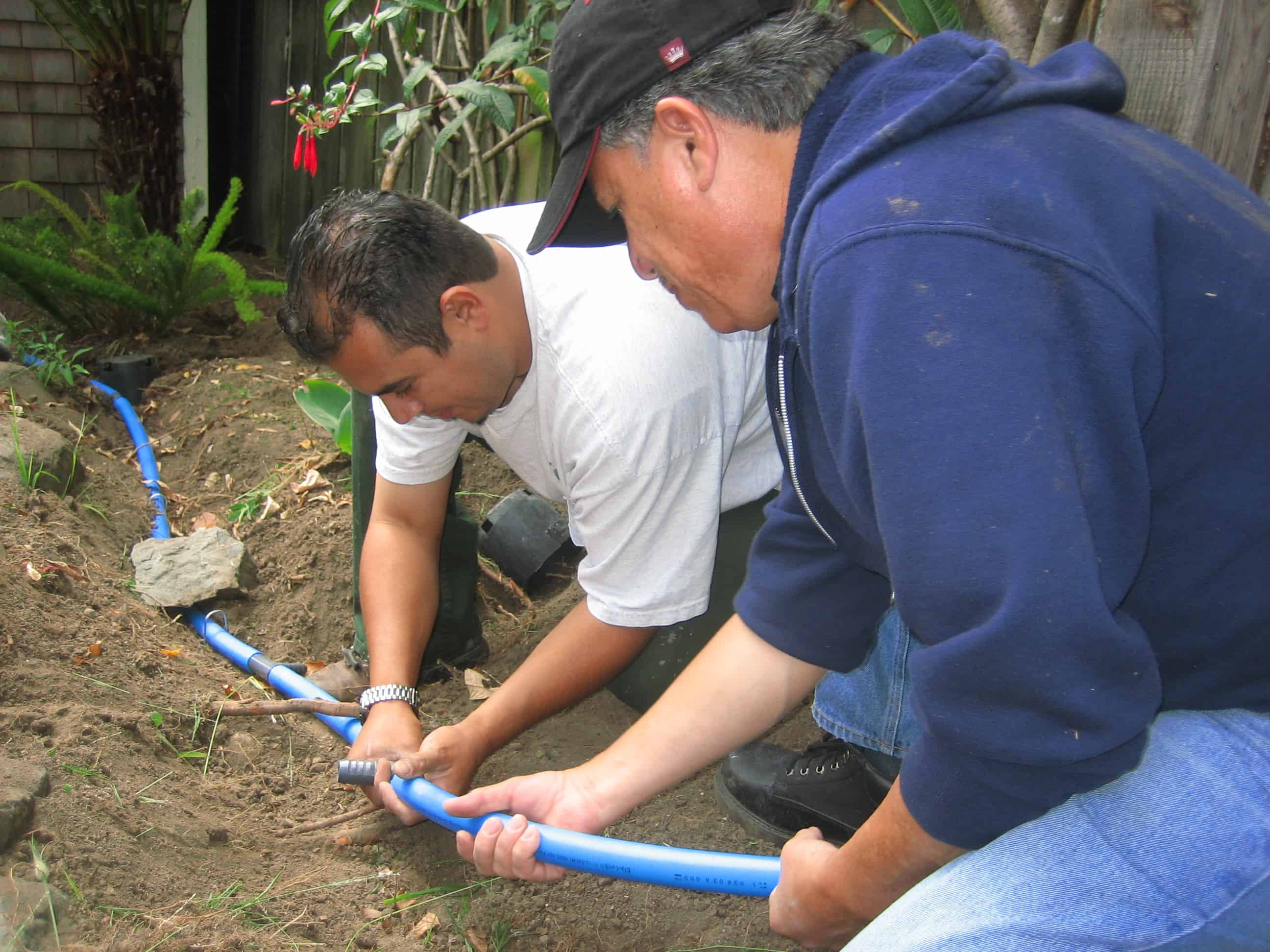 Greywater is gently used water from your bathroom sinks, showers, tubs, and washing machines. It is not water that has come into contact with feces, either from the toilet or from washing diapers.
Greywater may contain traces of dirt, food, grease, hair, and certain household cleaning products. While greywater may look “dirty,” it is a safe and even beneficial source of irrigation water in a yard. Keep in mind that if greywater is released into rivers, lakes, or estuaries, its nutrients become pollutants, but to plants, they are valuable fertilizer. Aside from the obvious benefits of saving water (and money on your water bill), reusing your greywater keeps it out of the sewer or septic system, thereby reducing the chance that it will pollute local water bodies. Reusing greywater for irrigation reconnects urban residents and our backyard gardens to the natural water cycle.
The easiest way to use greywater is to pipe it directly outside and use it to water ornamental plants or fruit trees. Greywater can also be used to irrigate vegetable plants as long as it doesn’t touch edible parts of the plants. In any greywater system, it is essential to use “plant friendly” products, those without lots of salt, boron, or chlorine bleach. The build-up of salts and boron in the soil can damage plants. While you’re at it, watch out for your own health: “natural” body products often contain substances toxic to humans (see resource pages below for details).
Our philosophy
We believe that for residential greywater systems simple designs are best. With simple systems you are not able to send greywater into an existing drip irrigation system, but must shape your landscape to allow water to infiltrate into the soil. We recommend simple, low-tech systems that use gravity when ever possible, instead of pumps. We prefer irrigation systems that are designed to avoid clogging, rather than relying on filters and drip irrigation.
We promote greywater reuse as a way to increase the productivity of sustainable backyard ecosystems that produce food, clean water, and shelter wildlife. Such systems recover valuable “waste” products–greywater, household compost, and humanure–and reconnect their human inhabitants to ecological cycles. By modeling “appropriate technologies” for food production, water, and sanitation in the industrialized world, we hope to replace the cultural misconception of “wastewater” with the possibility of a life-generating water culture.
We believe more complex systems are best suited for multi-family, commercial, and industrial scale systems. These systems can treat and reuse large volumes of water, and play a role in water conservation in dense urban housing developments, food processing and manufacturing facilities, schools, universities, and public buildings. Because complex systems rely on pumps and filtration systems, they are often designed by an engineer, are expensive to install and may require regular maintenance.
Basic Greywater Guidelines
Greywater is different from fresh water and requires different guidelines for it to be reused.
- Don’t store greywater (more than 24 hours). If you store greywater the nutrients in it will start to break down, creating bad odors.
- Minimize contact with greywater. Greywater could potentially contain a pathogen if an infected person’s feces got into the water, so your system should be designed for the water to soak into the ground and not be available for people or animals to drink.
- Infiltrate greywater into the ground, don’t allow it to pool up or run off (knowing how well water drains into your soil (or the soil percolation rate of your soil) will help with proper design. Pooling greywater can provide mosquito breeding grounds, as well as a place for human contact with greywater.
- Keep your system as simple as possible, avoid pumps, avoid filters that need upkeep. Simple systems last longer, require less maintenance, require less energy and cost less money.
- Install a 3-way valve for easy switching between the greywater system and the sewer/septic.
- Match the amount of greywater your plants will receive with their irrigation needs.
Types of Simple Systems
From the Washing Machine
Washing machines are typically the easiest source of greywater to reuse because greywater can be diverted without cutting into existing plumbing. Each machine has an internal pump that automatically pumps out the water- you can use that to your advantage to pump the greywater directly to your plants.
Laundry Drum:
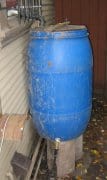
“Laundry drum.” Note: Drum should be strapped to the wall for safety.
If you don’t want to invest much money the system (maybe you are a renter), or have a lot of hardscape (concrete/patio) between your house and the area to irrigate, we recommend a laundry drum system.
Wash water is pumped into a “drum,” a large barrel or temporary storage called a surge tank. At the bottom of the drum the water drains out into a hose that is moved around the yard to irrigate. This is the cheapest and easiest system to install, but requires constant moving of the hose for it to be effective at irrigating
Laundry-to-Landscape:

Laundry-to-landscape system. Image credit: CleanWaterComponents
If you’re looking for system that gives you flexibility in what plants you’re able irrigate and takes very little maintenance, we recommend the laundry-to-landscape system. This system was invented by Art Ludwig.
This greywater system doesn’t alter the household plumbing: the washing machine drain hose is attached directly to a diverter valve that allows you to switch the flow of greywater between the sewer/septic and the greywater irrigation system. The greywater irrigation system directs water through 1″ tubing with 1/2″ outlets directing water to specific plants. This system is low cost, easy to install, and gives flexibility for irrigation. In most situations this is the number one place to start when choosing a greywater system!
From the Shower:
Showers are a great source of greywater- they usually produce a lot of relatively clean water. To have a simple, effective shower system consider a gravity-based system (no pump). If your yard is located uphill from the house, then you’ll need to have a pumped system.
Branched Drain:
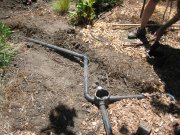 The branched drain system was also invented by Art Ludwig. Greywater in this system flows through standard (1 1/2″ size) drainage pipe, by gravity, always sloping downward at 2% slope, or 1/4 inch drop for every foot traveled horizontally, and the water is divided up into smaller and smaller quantities using a plumbing fitting that splits the flow. The final outlet of each branch flows into a mulched basin, usually to irrigate the root zone of trees or other large perennials. Branched drain systems are time consuming to install, but once finished require very little maintenance and work well for the long term.
From the Sinks:
Kitchen sinks are the source of a fair amount of water, usually very high in organic matter (food, grease, etc.). Kitchen sinks are not allowed under many greywater codes, but are allowed in some states, like Washington, Oregon, Arizona, and Montana. This water will clog many kinds of systems. To avoid clogging, we recommend using a branched drain system with mulch basins, organic matter collects in the woodchips and decomposes. Since bathroom sinks don’t typically generate much water, they can often combine flows with the shower water. Or, the sink water can be drained to a single large plant, or divided to irrigate two or three plants.
Constructed Wetlands:
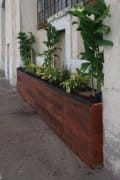 Constructed wetlands are used to “ecologically dispose” of greywater. If you produce more greywater than you need for irrigation, a constructed wetland can help use up some extra greywater. Wetlands absorb nutrients and filter particles from greywater, enabling it to be stored for longer or sent through a properly designed drip irrigation system (though more filtration and pumping is also required). Greywater is also a good source of irrigation for beautiful, water loving wetland plants. If you live near a natural waterway and don’t have anywhere else to direct greywater, a wetland can safely clean and soak-up greywater, protecting the creek. If you live in an arid climate, or are trying to reduce your fresh water use, we don’t recommend incorporating wetlands into greywater systems as they use up a lot of the water which could otherwise be used for irrigation.
Pumped Systems:
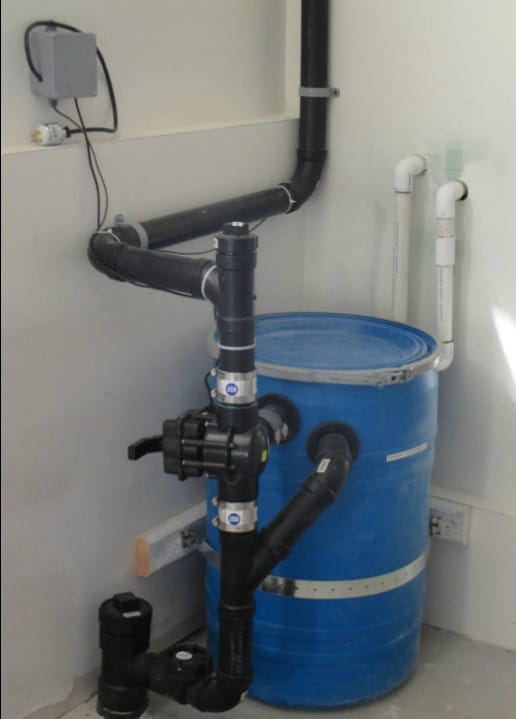
Pumped system. Image credit: Leigh Jerrard
If you can’t use gravity to transport the greywater (your yard is sloped uphill, or it’s flat and the plants are far away) you will need to pump greywater uphill. In a basic pumped system greywater flows into a large (usually 50 gallon) plastic barrel that is either buried or located at ground level. Inside the barrel an effluent pump pushes the water out through irrigation lines (no emitters) to the landscape. Pumps add cost, use electricity, and will break, so avoid this if you can.
Indoor Greywater Use
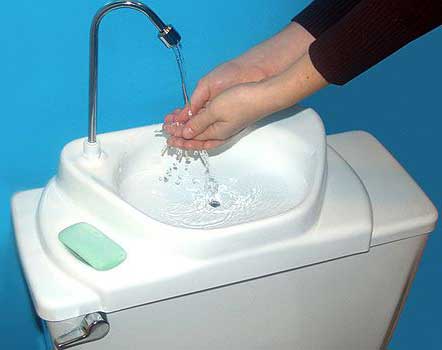
Sink Positive toilet lid
In most residential situations it is much simpler and more economical to utilize greywater outside, and not create a system that treats the water for indoor use. The exceptions are in houses that have high water use and minimal outdoor irrigation, and for larger buildings like apartments.
There are also very simple ways to reuse greywater inside that are not a “greywater system”. Buckets can catch greywater and clear water, the water wasted while warming up a shower. These buckets can be used to “bucket flush” a toilet, or carried outside. There are also simple designs like Sink Positive, and more complicated systems like the Brac system. Earthships have an interesting system that reuse greywater inside with greenhouse wetlands.
Plants and Greywater
 Low tech, simple greywater systems are best suited to specific, large plants. Use them to water trees, bushes, berry patches, shrubs, and large annuals. It’s much more difficult to water lots of small plants that are spread out over a large area. (like a lawn or flower bed)
Additional Greywater Information Pages
- Greywater friendly products
- Plants and greywater
- Laundry-to-landscape greywater system
- “Greywater-ready” new construction
- How to conduct a simple percolation test
- Manufactured greywater systems
- Commercial scale greywater systems
- Greywater systems in freezing climates
- Constructed wetland information
- Examples of greywater systems
- Greywater webinars on 11 different topics
- How to maintain your greywater system (with videos)
- Greywater resource page